

Motor Insurance
EV Tire Blowout Insurance Claim Rejections UAE 2026
Electric vehicle ownership in the UAE is rising fast — but so are insurance claim rejections linked to tire failures. If you drive a Tesla, BYD, MG, or Lucid, understanding why insurers deny EV tire blowout claims in 2026 could save you thousands of dirhams. This guide breaks down the technical exclusions, compliance standards, and practical steps to protect your motor insurance coverage before your next claim.
The Science of EV Tire Stress: Why Weight and Torque Matter in the UAE
Electric vehicles are, on average, 30% heavier than equivalent ICE cars due to their battery packs. A standard BYD Atto 3, for example, weighs nearly 1,800 kg — well above a comparable petrol SUV. This added mass creates disproportionate stress on tires, especially during the UAE's peak summer months when asphalt surface temperatures can exceed 70°C.
Then there is torque. EVs deliver maximum torque instantly from a standstill, a characteristic that accelerates sidewall stress and tread degradation far faster than conventional vehicles. UAE insurers and their technical adjusters increasingly recognize this as "predictable mechanical wear" rather than accidental damage.
The UAE's Ministry of Energy and Infrastructure (moei.gov.ae) has noted the rapid growth of EV registrations across emirates. However, standards for EV-specific tire ratings have not always kept pace in public awareness. Many owners still fit budget tires that were never engineered for high-load EV applications — a gap that insurers are now actively exploiting in their rejection letters.
If you're also worried about other EV-specific claim pitfalls, the guide on EV battery cooling failure and UAE insurance claims 2026 is worth reading alongside this one.
Top 5 Reasons for 2026 Insurance Claim Rejections in the Emirates
Claim rejection patterns have become more defined this year. Here are the five most common technical grounds insurers cite:
1. Sub-3.0mm Tread Depth The 2026 UAE Unified Motor Policy updates have tightened "wear and tear" exclusions for EVs. While the legal minimum tread depth under RTA rules remains 1.6mm, insurers now apply a stricter internal benchmark of 3.0mm for EVs. Tires below this threshold at the time of a blowout are classified as maintenance failures.
2. Non-HL Rated Tires Tires not bearing the HL (High Load) rating are flagged as non-compliant for vehicles above a certain gross weight. This is hitting Chinese EV brands — particularly BYD and Geely models — hardest, as budget tire fitments are common in the gray market segment.
3. Acoustic Foam Detachment EV-specific tires often include acoustic foam lining to reduce cabin noise. In 50°C UAE summer heat, this foam can delaminate inside the tire. If foam detachment contributes to a blowout, insurers investigate whether the driver maintained correct PSI levels. Improper inflation in extreme heat is classified as "Heat Negligence."
4. Telematics Data Flagging "Spirited Driving" Many 2026 EV models transmit driving behaviour data. Insurers are now using this data to identify repeated hard-acceleration events. Premature tire failure following a pattern of aggressive torque application can be rejected on "driver negligence" grounds.
5. Non-GCC Spec Vehicle Fitments Gray-market EVs not originally designed for GCC conditions may carry tires rated for cooler climates. This connects directly to the broader issue covered in the GCC vs non-GCC spec car insurance discussion — non-GCC spec vehicles face significantly narrower claim windows.
Standard vs. EV-Specific Tires: Compliance Factors for UAE Insurers
| Feature | Standard ICE Tire | EV-Specific (HL) Tire | Insurance Impact (2026) |
|---|---|---|---|
| Load Capacity | Standard (SL/XL) | High Load (HL) | Rejection if under-rated |
| Torque Resistance | Moderate | Reinforced Sidewalls | Premature wear flagged as "Negligence" |
| Noise Reduction | None | Acoustic Foam Lining | Foam detachment triggers Heat Negligence review |
| Heat Tolerance | Standard compound | GCC-grade compound | Non-GCC compound = claim exclusion risk |
| Tread Wear Indicator | 1.6mm legal minimum | 3.0mm insurer threshold | Gap between legal and insurer standards |
The Emirates Authority for Standardization and Metrology (moiat.gov.ae) sets standards for tire ratings sold in the UAE. However, parallel imports often bypass these requirements. Owners should verify their tire sidewall markings explicitly show HL ratings when fitting replacements.
For owners considering broader EV coverage questions, the guide on EV towing and dead battery cover in the UAE 2026 explains related exclusions worth reviewing now.
Compare & Choose on eSanad
The 2026 EV Tire Maintenance Checklist for GCC Residents
Protecting your claim eligibility comes down to documented, consistent maintenance. Follow this checklist:
- Check tire pressure weekly — EV battery weight means even minor under-inflation accelerates wear dramatically. Follow the manufacturer's cold-inflation PSI, not the tire sidewall maximum.
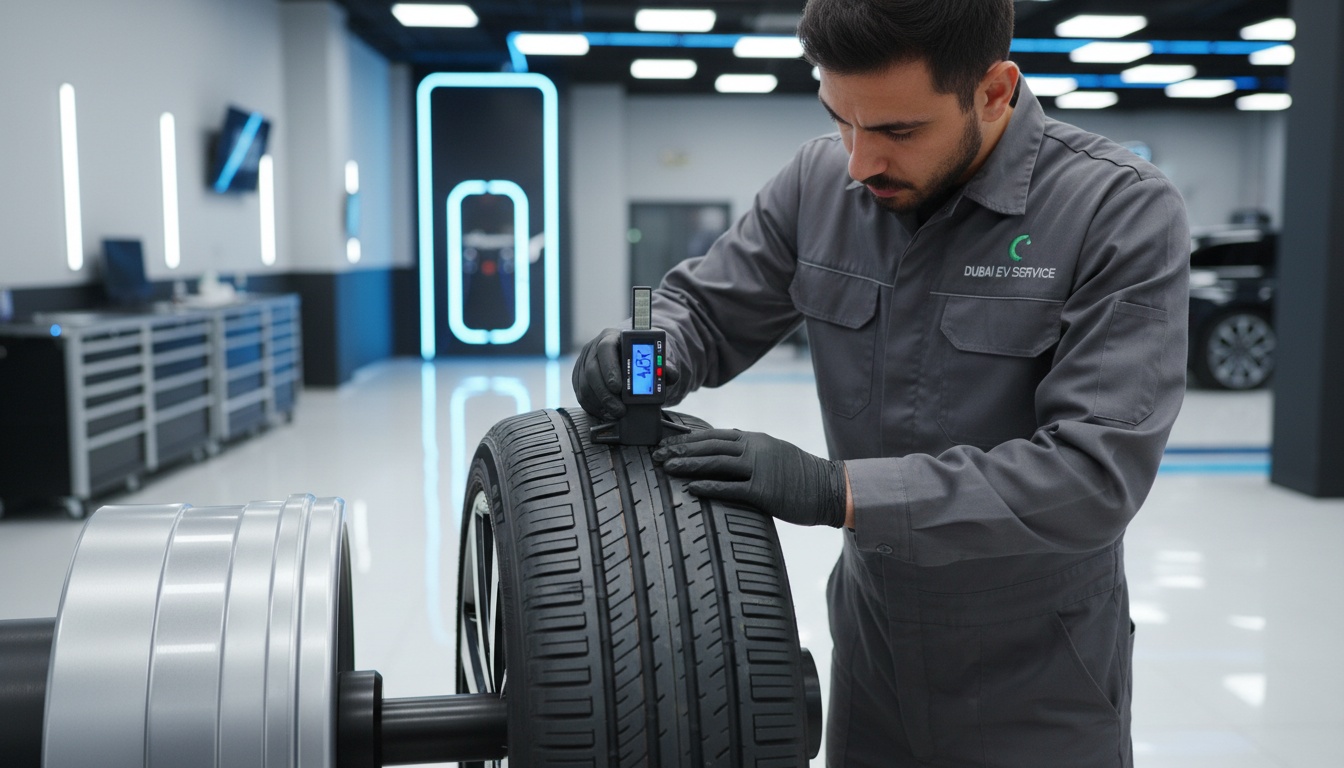
- Inspect tread depth monthly — Use a tread depth gauge. Replace tires when depth reaches 3.0mm, not the legal 1.6mm, to stay within insurer compliance thresholds.
- Rotate tires every 8,000 km — EV front tires wear faster due to regenerative braking patterns. Rotation extends uniform life.
- Verify HL rating before purchasing replacement tires — Ask your retailer to confirm HL certification in writing.
- Store service records — Garage-stamped records prove maintenance compliance if an adjuster investigates a claim.
- Avoid hard launches in summer — Telematics data from repeated 0-100 km/h acceleration on hot asphalt creates a paper trail insurers can use against you.
- Inspect acoustic foam lining annually — Ask your service center to check for delamination, particularly after UAE summers.
You can compare EV motor insurance plans on eSanad to find policies that offer explicit tire and blowout coverage language — before you need to make a claim.
Get a Free Quote Now
Conclusion
Bottom line: EV tire blowout claim rejections in the UAE are rising in 2026 because insurers are applying stricter technical standards around HL ratings, tread depth thresholds, and telematics evidence — standards that most EV owners simply aren't aware of. Understanding these exclusions and maintaining documented compliance is the only reliable defence against a rejected claim.
Short Summary: UAE insurers are rejecting EV tire blowout claims in 2026 over HL ratings, tread depth, and heat negligence — here's how to stay compliant.
Meta Description: EV tire blowout claims rejected in UAE 2026? Learn why HL ratings, tread depth rules, and telematics data are costing EV owners cover — and how to protect yours.
Slug: ev-tire-blowout-insurance-claim-rejections-uae-2026
FAQ
Does my UAE comprehensive policy cover a sudden blowout on the E11?
It depends on the cause. If the blowout is genuinely sudden and unrelated to wear, most comprehensive policies provide third-party damage coverage. However, if the adjuster finds tread depth below 3.0mm or a non-HL rated tire, the claim will likely be rejected as a maintenance failure under 2026 UAE Unified Motor Policy exclusions.
Will using non-EV tires void my entire motor insurance policy?
Not entirely, but it creates a significant exclusion. Any claim where the insurer determines that non-HL rated tires directly contributed to the incident — particularly tire failures and handling-related accidents — can be declined. Your third-party liability cover typically remains intact.
How does UAE summer heat specifically affect EV tire longevity?
Asphalt surface temperatures in the UAE regularly exceed 70°C in summer. Combined with the higher tire pressure that builds in heat, EV tires experience compound stress: rubber compound degradation, acoustic foam delamination, and sidewall fatigue occur far faster than in temperate climates, reducing usable tire life by up to 30%.
Why is 1.6mm tread depth not enough for EV insurance compliance in 2026?
The 1.6mm minimum is the legal roadworthiness standard set by the RTA. Insurance technical adjusters, however, apply internal benchmarks — typically 3.0mm for EVs — because of their heavier weight and braking demands. A tire legal for road use can still trigger a "wear and tear" rejection under your policy's fine print.
Can I claim for a tire blowout if I purchased my EV from a non-GCC gray market dealer?
This adds a layer of complexity. Non-GCC spec vehicles may have tires rated for different load and temperature profiles. Insurers can argue the vehicle was never compliant with UAE standards, making blowout claims extremely difficult to approve. Always verify GCC spec status before purchasing an EV and confirm coverage with your insurer upfront.
Editorial note: This article is for general information and does not constitute insurance advice. Always confirm terms with your insurer.